Imagine stepping off a tour bus and feeling the dry desert wind against your skin. Before you, emerging from a landscape sculpted by thousands of years of sand and sun, stand colossal stone monuments that seem to whisper the secrets of pharaohs, gods, triumphs, and mysteries. This is Egypt — an open‑air museum where every stone has a story, and every site is a chapter in a civilization that shaped human history. Join me on a journey through iconic landmarks that bring the history of Ancient Egypt to life, one unforgettable stop at a time.
1. The Pyramids of Giza — Beginning at the Dawn of Civilization
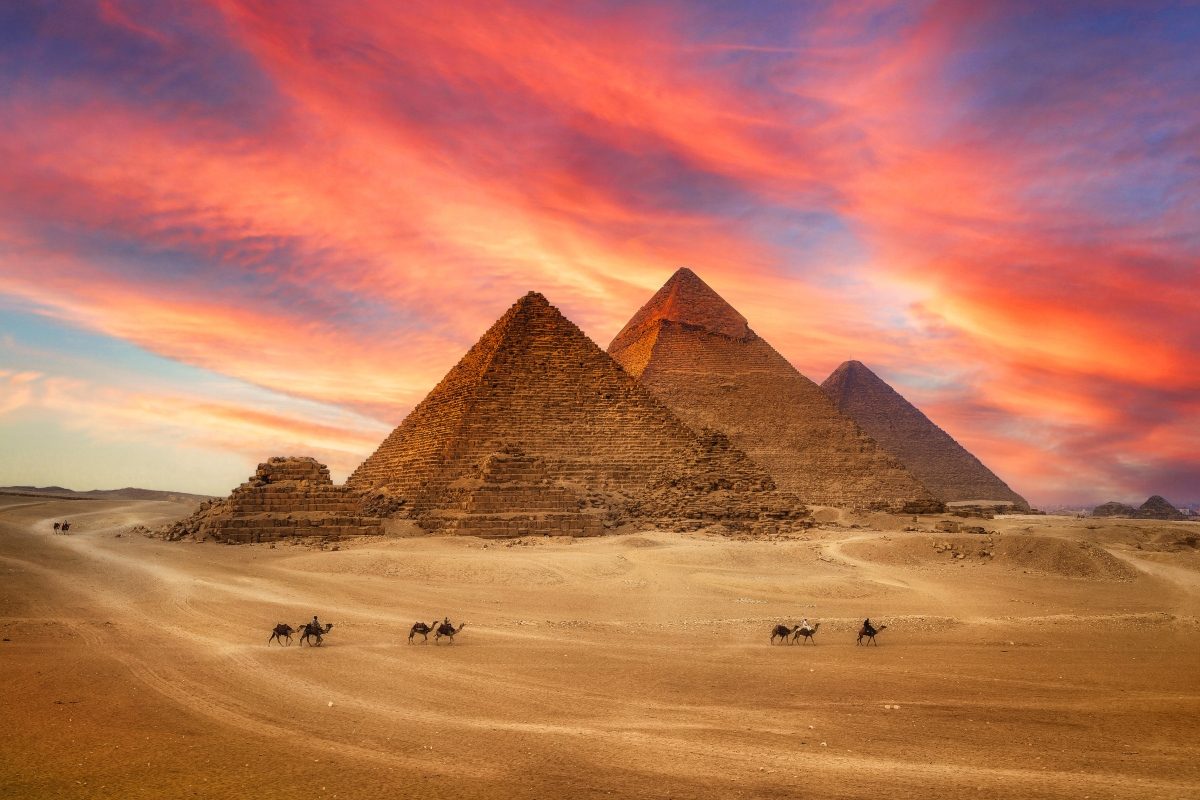
Most Egypt history tours begin at the site that defines Ancient Egypt in the world’s imagination: the Great Pyramids on the Giza Plateau.
Here, the colossal tombs of pharaohs Khufu, Khafre, and Menkaure rise in geometric perfection against the horizon. These structures were built during Egypt’s Old Kingdom (around 2600 BC) as magnificent burial monuments designed to ensure the pharaohs’ immortal journey to the afterlife. Each pyramid is part of a complex that includes mortuary temples and smaller pyramids for queens. The nearby Great Sphinx — a lion’s body with a human face — guards the plateau, its enigmatic gaze fixed eternally toward the rising sun.
Walking among these pyramids, you’re walking where ancient engineers and workers once maneuvered gigantic limestone blocks to build wonders that would still astound visitors millennia later.
2. The Grand Egyptian Museum — A Treasure Chest of Civilization
Just a short distance from the pyramids lies the soon‑to‑be‑or recently fully opened Grand Egyptian Museum (GEM) in Giza, a modern marvel dedicated to preserving and showcasing Ancient Egypt’s artifacts. It is designed to be the world’s largest museum focused on a single civilization and houses an immense collection of over 100,000 pieces. Highlights include artifacts from Tutankhamun’s tomb (including the gold mask) and the newly restored solar ship of Khufu, among many treasures.
This museum allows you to connect with the people behind the monuments — artisans, pharaohs, priests, and everyday Egyptians whose lives were intertwined with religion, governance, and cosmic beliefs.
3. Luxor — The World’s Greatest Open‑Air Museum
Travel south along the Nile and you arrive in Luxor, a city whose modern streets sit atop the ruins of ancient Thebes — once the capital of Egypt during the New Kingdom. Luxor is like stepping into a living tapestry of gods, kings, and dynasties.
a. Karnak Temple Complex – The City of a Thousand Columns
Begin your Luxor tour at the sprawling Karnak Temple, once Egypt’s most important religious center. For over two millennia, successive pharaohs expanded this sanctuary dedicated primarily to the god Amun‑Re. Walking through this temple is like moving through time itself — from towering pylons and endless rows of massive stone columns to sacred lakes and towering obelisks.
The Great Hypostyle Hall, with its forest of columns rising toward the sky, evokes the might of Egyptian religious authority and architectural innovation from the 19th Dynasty.
b. Avenue of Sphinxes — A Ceremonial Pathway Between Temples
Lined with hundreds of sphinxes, the Avenue of Sphinxes connects the Karnak Temple with Luxor Temple and once hosted grand processions celebrating religious festivals. Standing along this ancient ceremonial road, you can almost hear the footsteps of priests and worshippers from thousands of years ago.
c. Luxor Temple – The Heart of Ritual Life
Closer to Luxor’s city center lies the Luxor Temple, once a site of coronation rituals and divine celebrations. Its beautifully preserved reliefs and columns welcome visitors as dusk falls, a moment when the site’s golden stone seems to glow with ancient energy.
4. The Valley of the Kings — Where Pharaohs Rest for Eternity
One of the most compelling stops on any Egypt history tour is the Valley of the Kings, a dramatic desert valley on the west bank of the Nile where pharaohs of the New Kingdom (c. 1550–1075 BC) chose to be buried. These rock‑cut tombs replaced the towering pyramids of earlier eras, reflecting changing funerary practices and religious beliefs centered on the afterlife.
Here, the pharaohs’ tombs are hidden deep within limestone hills, decorated with elaborate hieroglyphic scenes meant to guide the deceased through the journey into eternity. Among them is Tutankhamun’s tomb — unearthed relatively intact in 1922 by Howard Carter — whose treasure‑filled burial chamber captivated the world and revealed more than ever before about royal burial customs.
The Valley of the Kings holds over 60 tombs, and while not all are open to visitors, each offers a unique insight into the spiritual and artistic world of Ancient Egypt.
5. Mortuary Temples and Colossi — Monuments to Memory and Power
Across the Valley’s plains lie grand structures built to honor the memory of pharaohs.
a. Hatshepsut’s Temple at Deir el‑Bahari
The elegant terraced temple of Queen Hatshepsut rises against a dramatic cliff face. Built to commemorate one of Egypt’s most successful rulers, its design is unmatched — blending architectural harmony with grandiose symbolism. Nearby, the mortuary complex of Mentuhotep II signals the town’s role as a sacred necropolis for centuries.
b. Colossi of Memnon — Guardians of an Ancient Legacy
On the west bank stand the massive Colossi of Memnon, two towering seated statues of Amenhotep III. After decades of restoration, these have been re‑erected to reflect their former grandeur and evoke the rich craft of New Kingdom sculpture.
6. Museums That Tell Personal Stories
Beyond the temples and tombs, Egypt’s museums offer context to the civilization’s grand narratives.
a. Luxor Museum
Overlooking the Nile, the Luxor Museum houses select artifacts from the region — statues, jewelry, and everyday items — in a curated setting that invites reflection on life in ancient Thebes.
b. Egyptian Museum of Antiquities (or National Museum of Egyptian Civilization)
While older museums have long held iconic artifacts from pharaonic times, newer institutions like the National Museum of Egyptian Civilization (which houses royal mummies in a dedicated display) and the Grand Egyptian Museum in Giza offer unprecedented access to the civilization’s long history through expertly preserved collections.
7. Why These Sites Matter on Egypt History Tours
Each of the sites on a classic Egypt history tour does more than offer a photo opportunity; they are chapters in the narrative of Ancient Egypt’s evolution:
- The Pyramids illustrate the Old Kingdom’s mastery of monumental architecture and its beliefs in the afterlife.
- The Grand Egyptian Museum contextualizes that legacy through curated artifacts.
- Karnak and Luxor Temples reveal the religious heart of New Kingdom Thebes.
- The Valley of the Kings immerses you in royal funerary traditions and the promise of immortality.
- Mortuary temples and colossal statues show how rulers sought both legacy and divine favor.
Together, these sites form a rich tapestry that allows travelers not just to see but to feel Ancient Egypt — a world both alien and familiar in its pursuit of meaning, power, and everlasting memory.
Conclusion — Walking Through Time
A journey through Egypt’s most iconic archaeological sites is stepping into history itself — from the silent desert of the Giza Plateau to the shaded corridors of royal tombs in Luxor. This is the essence of Egypt history tours: immersive, awe‑inspiring journeys where each site opens a window into lives lived thousands of years ago.
Whether you’re drawn by the grandeur of pyramids or the quiet mysteries of hidden crypts, Egypt offers a narrative that few places on Earth can match — a civilization whose echoes still resonate in stone, sand, and memory.